

How to Create Journal: A Step-by-Step Guide for Publishers
Learn how to create journal from scratch - scope, editorial board, ISSN, website, and peer review. A practical guide for academic publishers using ScholarJMS.
How to Create Journal: A Step-by-Step Guide for Publishers Academic journals are the backbone of scholarly communication. They give researchers a...
How to Create Journal: A Step-by-Step Guide for Publishers
Academic journals are the backbone of scholarly communication. They give researchers a formal, citable venue to share findings, allow ideas to be scrutinized through peer review, and help build the collective record that other scholars build upon. Without journals, research would remain scattered across personal websites, conference slides, and unreviewed drafts - with no consistent quality control and no lasting archive.
For all their importance, most people who want to start one quickly run into the same question: how to create journal that is credible, sustainable, and genuinely useful to a research community? The process can feel daunting at first. It involves editorial decisions, policy writing, technical infrastructure, and ongoing operational work - not just publishing a few articles online.
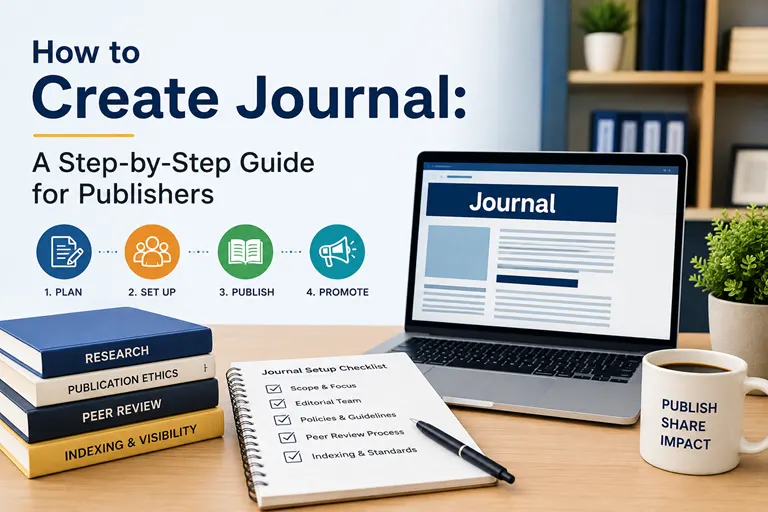
The good news is that the process becomes much more manageable when broken into clear steps. This guide walks through everything involved in launching an academic journal, from choosing a subject area to setting up peer review and publishing your first issue. Along the way, we'll also look at how modern journal management software, such as ScholarJMS, can simplify the operational side of running a journal so editorial teams can focus on content quality rather than administrative overhead.
Whether you're an academic institution starting a departmental journal, an independent group of researchers launching a niche publication, or a publisher expanding a portfolio, the fundamentals below apply broadly.
What Is an Academic Journal?
An academic journal is a periodical publication containing scholarly articles that have typically undergone peer review - evaluation by independent experts in the same field before publication. Journals exist to communicate original research, critical analyses, methodological advances, and reviews of existing literature to a specialized audience.
Academic journals differ from general magazines in several important ways:
- Purpose: Journals exist to advance knowledge within a discipline, not to entertain or inform a general audience.
- Review process: Articles go through peer review, where subject-matter experts assess methodology, originality, and validity before publication.
- Authorship: Contributors are typically researchers, academics, or practitioners writing within their area of expertise.
- Structure: Journals are usually organized into volumes and issues, published on a regular schedule, with each article carrying formal citation metadata.
- Audience: Readers are typically other researchers, students, and professionals seeking authoritative, citable sources.
Journals play a central role in research communication. They provide a mechanism for quality control through peer review, a permanent record through archiving, and a way for new findings to reach the people who will build on them. This is why launching a journal is not simply a publishing exercise - it's an editorial and institutional commitment.
How to Create Journal: Step-by-Step Guide
Creating a journal involves a sequence of editorial, policy, and technical decisions. Below is a structured path through the process.
1. Choose Your Journal's Subject and Scope
The first decision in learning how to start an academic journal is defining exactly what it will cover. This shapes everything that follows - your editorial board, your audience, your submission volume, and your long-term identity.
To choose a subject and scope:
- Select a research discipline that reflects either your own expertise or the expertise of your founding editorial team. A journal without genuine subject-matter authority behind it will struggle to attract quality submissions and reviewers.
- Define the scope precisely. A journal that tries to cover "all of science" will struggle to build a coherent identity or reviewer pool. A journal focused on a well-defined niche - say, computational methods in ecological modeling - is easier to position and staff.
- Identify your target audience. Are you serving researchers in a specific subfield, practitioners applying research in the field, or a mix of both?
- Analyze existing journals in the space. Look at what's already being published, which topics are underserved, and where genuine gaps exist.
- Find a unique publishing focus. This could be a specific methodology, a regional focus, an interdisciplinary angle, or a format (e.g., short communications, case studies) that isn't well served elsewhere.
Getting this right early prevents costly repositioning later.
2. Choose a Journal Name
A journal's name is part of its long-term credibility. Once established, changing it can create confusion, break existing citations, and complicate indexing. Choose carefully.
Best practices include:
- Relevance: The name should clearly signal the subject area to anyone browsing search results or a library catalog.
- Uniqueness: Check that the name doesn't closely resemble an existing journal - this avoids reader confusion and potential legal issues.
- Professional appearance: Avoid overly casual or generic names. Academic readers associate certain naming conventions ("Journal of X," "International Review of Y") with credibility.
- Avoiding confusing or misleading names: Don't imply a broader scope, institutional affiliation, or indexing status than what actually exists.
A quick search of existing journal title databases and general web searches can help confirm your chosen name isn't already in use.
3. Define the Journal's Aims and Scope
The "Aims and Scope" statement is a foundational document that appears on nearly every journal website. It tells authors, readers, and indexing services exactly what the journal publishes and why.
A strong aims and scope statement typically includes:
- The specific subject areas and subtopics covered
- The types of articles accepted (original research, reviews, case studies, short communications, etc.)
- The intended audience
- What distinguishes the journal from others in the same space
- Any methodological or geographic focus
This document should be revisited periodically as the journal matures, but it needs to be clear and specific from day one - vague scope statements make it harder for authors to judge fit and for editors to make consistent acceptance decisions.
4. Build an Editorial Board
A journal's credibility rests heavily on its editorial team. Building a strong board is one of the most important steps in how to create an academic journal that researchers will trust and want to publish in.
Key roles typically include:
- Editor-in-Chief: Sets overall editorial direction, makes final decisions on contested submissions, and represents the journal publicly.
- Associate/Managing Editors: Handle day-to-day editorial workflow, assign reviewers, and manage timelines.
- Editorial Board Members: Provide subject-matter expertise, help set editorial policy, and often assist with reviewer recruitment.
- Reviewer network: A pool of qualified peer reviewers across the journal's subfields, large enough to avoid overburdening any single reviewer.
Subject-matter expertise across the board is essential - not just for credibility, but for making sound editorial decisions and providing authors with meaningful feedback. A well-rounded board should also reflect a range of institutional and geographic backgrounds where possible, which strengthens both editorial judgment and the journal's international relevance.
5. Establish Author and Editorial Policies
Clear, publicly available policies protect the journal's integrity and set expectations for authors, reviewers, and editors alike. At minimum, a new journal should establish:
- Submission guidelines: Formatting requirements, word limits, required sections, and file types.
- Peer-review policy: Whether review is single-blind, double-blind, or open, and how reviewers are selected.
- Publication ethics: Standards addressing authorship criteria, duplicate submission, and research integrity, often aligned with frameworks like COPE.
- Plagiarism policy: How submissions are screened and what happens when issues are found.
- Conflict of interest: Disclosure requirements for authors, reviewers, and editors.
- Copyright: Whether authors retain copyright, what license is applied (e.g., Creative Commons), and reuse terms.
- Retraction policy: The process for retracting or correcting published articles when necessary.
- Corrections: How minor errors are handled post-publication.
- Data availability: Expectations around sharing underlying research data, where applicable to the field.
Having these documented and published builds trust with authors and is often a prerequisite for indexing consideration later on.
6. Apply for an ISSN
An ISSN (International Standard Serial Number) is a unique identifier assigned to a periodical publication, used to distinguish it from other serials with similar titles. Having an ISSN for a journal is generally expected for formal recognition and is often a requirement for indexing and library cataloging.
ISSN registration is typically handled through national ISSN centers, which are country-specific and part of the International ISSN Network. Since application processes, required documentation, and eligibility rules vary by country and can change over time, it's best to consult your national ISSN center directly for current requirements rather than relying on general guidance.
7. Create a Professional Journal Website
Your journal's website is its public face and operational hub. Authors, reviewers, and readers will judge credibility partly by how complete and professional the site looks. A well-structured journal website typically includes:
- Home: Overview and recent highlights
- About the Journal: Mission, history, and background
- Aims and Scope: The statement defined in Step 3
- Editorial Board: Names, affiliations, and roles
- Instructions for Authors: Submission formatting and requirements
- Submit Manuscript: Link or portal to the submission system
- Current Issue: The latest published volume/issue
- Archives: Past issues, organized by volume and year
- Publication Ethics: Policies from Step 5
- Peer Review Policy: How review works
- Contact: Editorial office details
- Copyright/License Information: Terms under which content is published and reused
A journal management platform can generate and maintain many of these pages automatically as part of a structured journal website, reducing the need to build and manage a separate custom site from scratch.
8. Set Up Manuscript Submission and Peer Review
At the operational core of any journal is its manuscript workflow. A typical process looks like this:
Author Submission → Editorial Screening → Peer Review → Revision → Final Decision → Copyediting → Production → Publication
Each stage requires coordination:
- Editorial screening checks scope fit, formatting, and basic ethical compliance before sending a manuscript out for review.
- Peer review involves assigning qualified reviewers, tracking review timelines, and collecting structured feedback.
- Revision cycles require version tracking and clear communication between authors and editors.
- Final decision (accept, reject, or further revision) is made by the editor based on reviewer input.
- Copyediting and production prepare accepted manuscripts for formal publication, including formatting and metadata tagging.
Managing this manually - through email and spreadsheets - becomes difficult to sustain even at moderate submission volumes. This is where an online journal management system becomes genuinely useful: it centralizes submissions, automates reviewer assignment and reminders, tracks manuscript status, and keeps a clear audit trail for every decision.
9. Publish Your First Issue
Once you have accepted manuscripts ready for production, it's time to assemble your first issue. Consider:
- Article selection: Ensure the issue reflects the journal's stated scope and quality standards.
- Volume and issue structure: Decide on a numbering convention (e.g., Volume 1, Issue 1) and how frequently issues will be released.
- Article formatting: Apply consistent formatting, citation style, and layout across all articles.
- Publication dates: Set a realistic, sustainable schedule rather than an aggressive one you can't maintain long-term.
- Online publication: Publish the issue on your journal website with proper metadata for each article.
- Journal archives: Ensure past issues remain accessible and well-organized as the archive grows.
A strong, well-organized first issue sets the tone for how the journal will be perceived going forward.
10. Consider DOI and Indexing
A DOI (Digital Object Identifier) is a persistent identifier assigned to individual articles, ensuring they remain findable and citable even if URLs change over time. Assigning DOIs is a standard practice in academic journal publishing and supports:
- Persistent article identification: Readers and citation tools can always locate the article via its DOI.
- Metadata: DOIs are linked to structured metadata (authors, title, abstract, publication date) that feeds into scholarly databases.
- Scholarly discoverability: Proper metadata and DOI registration help articles surface in citation trackers and search tools.
Regarding indexing: services like Google Scholar, Scopus, Web of Science, and DOAJ each maintain their own independent evaluation criteria covering editorial quality, peer-review rigor, publication consistency, and ethical standards. No journal - new or established - can guarantee acceptance into any indexing service. Meeting a service's requirements takes time, a consistent publication track record, and adherence to established editorial practices. Be wary of any guidance that promises guaranteed indexing outcomes.
Need Expert Support for Journal Publishing?
Get professional guidance for journal publishing technology, OJS, and digital publishing solutions.
Mr. Darshan Patel (ME-CE)
COO & Journal Publishing Technology ConsultantSequence Research & Development Pvt. Ltd.
Ahmedabad | Gujarat | IndiaHow ScholarJMS Helps You Create and Manage a Journal
Building a journal from scratch involves coordinating a lot of moving parts - editorial workflow, manuscript tracking, reviewer communication, website content, and issue publishing. ScholarJMS is a journal management and publishing platform built to help publishers, editors, and institutions manage these pieces from a centralized system rather than juggling separate tools.
Areas where a platform like ScholarJMS can support journal creation and ongoing operations include:
- Journal website management: Maintaining core pages like aims and scope, editorial board listings, and archives in one place.
- Manuscript submissions: Giving authors a structured portal to submit manuscripts and track status.
- Editorial workflow: Routing manuscripts through screening, review assignment, and decision stages.
- Peer review: Coordinating reviewer invitations, submissions, and feedback within the system.
- Author communication: Keeping correspondence tied to each manuscript's record.
- Reviewer management: Maintaining a reviewer database organized by subject expertise.
- Article management: Tracking manuscripts from submission through copyediting and production.
- Issues and archives: Organizing published content into volumes and issues with a browsable archive.
- Publication workflow: Supporting the process from acceptance to final online publication.
- Journal administration: Giving editorial teams a central dashboard to oversee journal operations.
For publishers evaluating how to create journal infrastructure without building custom systems from the ground up, a centralized platform can reduce the operational burden significantly. Explore ScholarJMS to simplify your journal publishing workflow.
Common Mistakes to Avoid When Creating a Journal
New journal founders often run into avoidable problems. Common pitfalls include:
- Choosing an overly broad scope, making it hard to build a coherent identity or attract the right reviewers.
- Not defining editorial responsibilities clearly, leading to bottlenecks or inconsistent decisions.
- Having an unclear peer-review process, which undermines both quality control and author trust.
- Poor website structure, making it hard for authors and readers to find essential information.
- Missing publication policies, leaving ethical and procedural gaps that can cause problems later.
- Inconsistent article formatting, which looks unprofessional and complicates indexing.
- Ignoring publication ethics, risking the journal's credibility and academic standing.
- Publishing low-quality or unrelated articles just to fill issues, which damages long-term reputation.
- Making unrealistic indexing claims, which can mislead authors and erode trust.
- Not maintaining regular publication schedules, which signals instability to authors and readers.
Avoiding these issues from the outset makes it far easier to build a sustainable, respected publication.
How Long Does It Take to Create a Journal?
There's no fixed timeline for launching an academic journal - it depends heavily on several interconnected factors:
- How quickly a qualified editorial board can be assembled
- How long website setup and content preparation takes
- How thoroughly publishing policies are developed
- The ISSN application timeline in your country
- Time needed to configure a manuscript submission system
- How much manuscript content is already available or in the pipeline
- Peer-review turnaround times once submissions begin
- Production and copyediting workflow speed
Some founding teams move through these steps in a few months if they have existing networks and content ready; others take a year or more to build a solid foundation before publishing their first issue. Rushing the process to hit an arbitrary launch date often leads to weaker editorial standards - it's generally better to take the time needed to get the fundamentals right.
What Do You Need to Start an Academic Journal?
A concise checklist for founders:
- A clear, well-defined journal name
- A specific subject area and scope
- A qualified editorial board
- A network of peer reviewers
- Documented publishing policies (ethics, peer review, copyright, etc.)
- A professional journal website
- A manuscript submission system
- A structured peer-review workflow
- An ISSN registration
- Consistent article templates and formatting standards
- A realistic, sustainable publication schedule
- A DOI assignment strategy
- A journal management platform to coordinate operations
FAQ Section
How do I create a journal?
Creating a journal involves defining your subject scope, building an editorial board, establishing publishing and peer-review policies, registering an ISSN, setting up a journal website and submission system, and publishing issues on a consistent schedule. Journal management software can help coordinate these steps in one place.
How do I start an academic journal?
Start by selecting a well-defined research area, forming an editorial board with genuine subject-matter expertise, and drafting your aims and scope statement. From there, establish editorial policies, build a submission and peer-review workflow, and set up a professional journal website before publishing your first issue.
What do I need to create a scholarly journal?
At minimum, you need a defined scope, an editorial board, reviewer network, documented policies (peer review, ethics, copyright), a journal website, a manuscript submission system, and an ISSN. Most journals also plan for DOI assignment and future indexing opportunities.
Do I need an ISSN to publish a journal?
An ISSN is generally expected for formal recognition of a periodical and is often required for library cataloging and indexing consideration. Application processes vary by country, so check with your national ISSN center for specific requirements.
How can I create a journal website?
A journal website should include core pages such as About, Aims and Scope, Editorial Board, Instructions for Authors, Submission access, Current Issue, Archives, and policy pages. Journal management platforms like ScholarJMS can help generate and maintain these pages alongside your editorial workflow.
How does journal management software help publishers?
Journal management software centralizes manuscript submissions, peer review coordination, editorial decision tracking, and issue publishing, reducing reliance on manual processes like email and spreadsheets. This helps editorial teams manage growing submission volumes more consistently.
Can ScholarJMS help manage an academic journal?
Yes. ScholarJMS is a journal management and publishing platform that supports areas such as manuscript submissions, editorial workflow, peer review coordination, reviewer management, and issue publishing from a centralized system.
How can I publish research papers in my journal?
Once your editorial workflow and peer-review process are in place, accepted manuscripts move through copyediting and production before being formatted and published as part of a structured issue, typically organized by volume and issue number with appropriate metadata for each article.
Conclusion
Learning how to create journal infrastructure that lasts requires more than simply putting a website online. It requires a clearly defined academic scope, strong editorial leadership, a reliable peer-review process, transparent publishing policies, and consistent publication practices sustained over time. Each of these elements builds on the others - a well-defined scope attracts the right editorial board, a strong board sustains rigorous peer review, and consistent policies build the trust that keeps authors submitting.
Platforms like ScholarJMS can help streamline the operational side of this process - from manuscript submissions to editorial workflow and issue publishing - so editorial teams can focus more on the substance of the research they publish. Explore ScholarJMS to see how it can support your journal's publishing workflow from launch onward.