

Journal Transfers: ISSN, DOIs & Metadata Stewardship
Learn how publisher transfers affect ISSN, DOIs, metadata, indexing & discoverability. Step-by-step workflow, best practices, myths & FAQs for smooth journal transitions.
Introduction When a journal changes hands—whether through acquisition, merger, or outsourcing—editors often worry about more than c...
Introduction
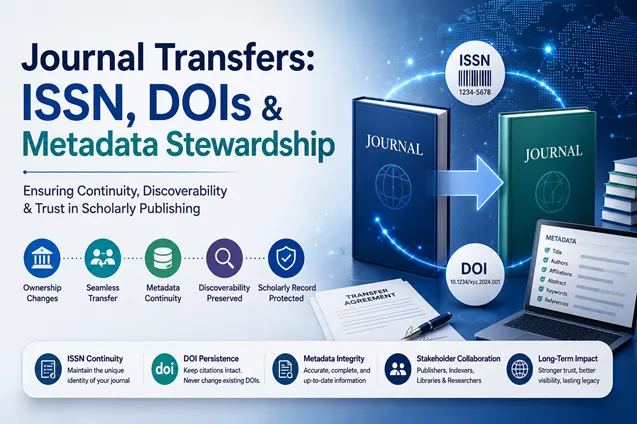
When a journal changes hands—whether through acquisition, merger, or outsourcing—editors often worry about more than contracts and hosting. They must also safeguard the identifiers and metadata that keep the publication discoverable: the ISSN, the DOIs, and the rich records that power indexing, citations, and long-term preservation. This comprehensive guide explains how to manage journal transfers responsibly, using the ISSN Transfer Alerting Service (TAS/ETAS) and the Crossref transfer process, while honoring the NISO Transfer Code of Practice.
What is a Journal Transfer?
A journal transfer is the formal hand-over of publishing responsibility from one organization (“transferring publisher”) to another (“receiving publisher”). The change may involve ownership, hosting, editorial control, or all three.
Why Journal Transfers Happen
- Mergers & acquisitions – a large house buys a smaller imprint.
- Strategic refocus – societies outsource to professional publishers.
- Platform migration – journals leave legacy systems for modern SaaS such as ScholarJMS.
- Open-access flipping – journals move to OA service providers.
Each scenario triggers ripple effects on identifiers, metadata, and stakeholder workflows.
Understanding the ISSN International Centre Transfer Alerting Service (TAS / ETAS)
The ISSN International Centre hosts the Enhanced Transfer Alerting Service (ETAS), a public database and email/RSS alert system that records journal transfer notices, ensuring librarians, aggregators, and indexing services are informed with minimal delay. Publishers registered with the ETAS must announce every incoming title, supplying ISSN(s), effective date, and contact details.
Understanding the NISO Transfer Code of Practice
The NISO Code sets community-agreed rules for ethical journal transfers: advance notice, continued content access, clear contact points, and transparent metadata handover. Compliance with the Code is now a de facto expectation for reputable publishers and a prerequisite for many library contracts.
Why Publisher Transfers Matter in Scholarly Publishing
- Continuity of access – readers, link resolvers, and preservation services rely on stable URLs.
- Citation integrity – DOIs must keep resolving so references don’t break.
- Indexing & metrics – databases need updated metadata to tally citations correctly.
- Author trust – smooth transitions protect author reputation and article visibility.
What Happens to ISSN During a Journal Transfer?
The ISSN (print and online) identifies the continuing serial. Ownership doesn’t change; instead, the receiving publisher notifies the ISSN International Centre (directly or via ETAS) so global catalogues and knowledge bases update the publisher field. If a title genuinely changes name or medium, a new ISSN may be assigned, but most transfers keep the original ISSN pair.
What Happens to DOIs During a Journal Transfer?
Unlike ISSN, DOIs include ownership metadata inside the Crossref registry. The DOI string itself should never change; stewardship simply moves from one Crossref member to another.
Understanding Crossref DOI Ownership
Title Ownership Transfer
Most transfers move a single title. Crossref updates the title record so future DOIs use the receiving publisher’s prefix while past DOIs keep their original prefix.
Prefix Ownership Transfer
If a whole publishing house is acquired, the entire DOI prefix can move, carrying all titles and permissions with it.
DOI Prefix vs DOI Ownership
A DOI’s visible prefix may differ from the current owner in Crossref’s backend. Ownership rather than prefix determines who can update metadata or mint new DOIs.
How Crossref Handles DOI Transfers
- Ownership concept – each title is linked to one member account.
- Receiving member – gains rights to update existing DOIs and register new ones.
- Transferring member – loses those rights but remains cited in provenance history.
- Metadata responsibility – shifts to the new steward, who must correct URLs and Crossmark data.
- Existing DOI management – old DOIs stay live; only the landing page URL changes.
- Future DOI registration – must use the receiving publisher’s prefix if the title record now points there.
Crossref Transfer Process
Step 1 – Preparation Before Transfer
Both publishers verify that all published articles already have registered DOIs and that financial arrangements for DOI deposits are settled.
Step 2 – Transfer Request
The transferring or receiving publisher submits a title transfer request to Crossref, ideally citing an ETAS notice as proof of consent.
Step 3 – Crossref Ownership Update
Crossref staff relink the title (or prefix) to the receiving member account and confirm completion.
Step 4 – Metadata Maintenance
The new publisher bulk-updates landing-page URLs, Crossmark statements, license links, Similarity-Check full-text URLs, and any member-specific fields.
Why Existing DOIs Should Never Change
- Persistence – the core DOI principle is “once assigned, always assigned.”
- Citation integrity – changing identifiers breaks reference graphs.
- Research continuity – funders and assessment systems expect stable links.
- Metadata consistency – multiple DOIs for the same item create duplication.
- URL updates – only the resource URL should shift to the new site.
- Resolution updates – Crossref handles redirecting the unchanged DOI to the new location.
Metadata Updates After Transfer
Key fields the receiving publisher must review:
- Landing-page URLs (HTML, PDF, XML)
- Publisher name & imprint
- Crossmark and update policies
- Full-text & Similarity-Check URLs
- License and open-access indicators
- Funding data & ORCID records
Failure to update leads to broken links, wrong branding, or missing compliance flags in indexes.
Journal Transfer Workflow
| Step | Task | Responsible Party | Key Deliverables |
|---|---|---|---|
| 1 | Audit existing DOIs & metadata | Transferring publisher | DOI list, registration status, fee clearance |
| 2 | Publish ETAS notice & inform Crossref | Both publishers | ETAS record, transfer request form |
| 3 | Sign data-exchange agreement & hand over assets | Both publishers | XML archives, style sheets, platform credentials |
| 4 | Crossref updates title/prefix ownership | Crossref | Confirmation email, new ownership record |
| 5 | Migrate content & hosting platform | Receiving publisher | Live site with back-issue content |
| 6 | Bulk-update DOI URLs & metadata | Receiving publisher | Updated landing pages, Crossmark JSON |
| 7 | Validate redirects, resolve errors | Both publishers | 100 % DOI resolution success |
| 8 | Communicate change to stakeholders | Receiving publisher | Emails to authors, editors, indexers, librarians |
| 9 | Monitor metrics & citations | Receiving publisher | Post-transfer analytics report |
| 10 | Close-out & compliance check | Crossref & ISSN Centre | Final confirmation, dispute window closed |
Journal Transfer vs DOI Transfer
| Aspect | Journal Transfer (Full Title) | DOI Transfer (Individual Records) |
|---|---|---|
| Scope | Whole serial publication | Selected articles or volumes |
| Identifier impact | ISSN stays, DOIs move as a set | Only specified DOIs change ownership |
| Prefix change | Sometimes (future DOIs) | Never (string unchanged) |
| ETAS notice required | Yes | Usually no |
| Typical use case | Publisher acquisition | Content split across hosts |
| Metadata hand-over | Complete journal metadata | Record-level metadata only |
ISSN vs DOI Responsibilities During Publisher Transfer
| Activity | ISSN Authority / Publisher | DOI Registration Agency / Publisher |
|---|---|---|
| Record transfer notice | ETAS submission by receiving publisher | Crossref title transfer request |
| Identifier string change | Rare (only on title change) | Never |
| Metadata host update | ISSN Portal | Crossref Registry |
| URL redirection | Library knowledge-bases | DOI resolution target |
| Preservation audit | Keepers Registry | Crossref/PORTICO links |
| Dispute resolution | ISSN International Centre | Crossref Membership & dispute policy |
Benefits for Publishers
- Protect brand integrity and citation counts.
- Avoid costly re-registration of DOIs.
- Streamline discovery in indexes and search engines.
- Demonstrate professionalism to authors and libraries.
Benefits for Editors
- Minimal disruption to peer-review workflow.
- Confidence that back-issue links remain live.
Benefits for Researchers
- Stable links in CVs, grant reports, and systematic reviews.
Benefits for Authors
- No need to amend references or promotion dossiers.
Benefits for Libraries
- Timely holdings updates via ETAS feed.
- Accurate link-resolver targets.
Benefits for Indexing Services
- Rapid ingestion of updated metadata, reducing duplicate entries.
Common Challenges During Journal Transfers
- Missing DOI deposits for older issues.
- Broken redirects after CMS migration.
- Conflicting metadata between publishers.
- Delayed ETAS notices causing catalog confusion.
- Disputes over ownership when society and publisher disagree.
Common DOI Transfer Mistakes
- Creating duplicate DOIs for already-registered articles.
- Minting new DOIs instead of updating URLs.
- Forgetting Crossmark updates, leaving stale policies online.
- Leaving broken landing pages that return 404 errors.
- Using incorrect protocol (http vs https) in resource URLs.
- Omitting license metadata, breaking OA compliance.
Best Practices
- Announce transfers early via ETAS and publisher blogs.
- Exchange complete XML and deposit reports before day 0.
- Use Crossref’s title-transfer form instead of email chains.
- Run automated DOI-resolution tests post-migration.
- Update Crossmark, ORCID, and funding data concurrently.
- Keep the old site alive with redirects for at least 12 months.
- Document every change for auditors and indexers.
- Train editorial staff on new prefixes and deposit credentials.
Common Myths
| Myth | Reality |
|---|---|
| 1. “We must mint new DOIs with our prefix.” | Never replace existing DOIs; update metadata instead. |
| 2. “ISSN changes ownership automatically.” | A formal ETAS notice is required. |
| 3. “Changing prefixes breaks citations.” | Prefix differences are fine if URLs resolve. |
| 4. “Libraries don’t care about transfer notices.” | Many rely on ETAS feeds to update holdings. |
| 5. “Metadata updates cost extra.” | Crossref does not charge for updating existing records. |
| 6. “We can delete obsolete DOIs.” | DOIs are permanent; they can be deprecated but not deleted. |
| 7. “Prefix transfer is faster than title transfer.” | Prefix moves are complex and require re-registration if moving between agencies. |
| 8. “Transfer only affects technical staff.” | Editors, marketers, and authors are equally impacted. |
Real-World Example
Scenario: Publisher A (prefix 10.1234) sells Journal of Green Chemistry (ISSN 1234-5678) to Publisher B (prefix 10.9876).
- ISSN – Publisher B files an ETAS notice listing both ISSNs and effective date. The ISSN Portal now shows Publisher B as the publisher of record.
- Existing DOIs – All 1,200 article DOIs keep the 10.1234 prefix. Publisher B gains permission to update their metadata (e.g., new URLs).
- New DOIs – Future articles get DOIs starting with 10.9876 because the title record now points to Publisher B’s prefix.
- Metadata – Publisher B bulk-updates landing-page URLs, Crossmark policies, and license tags.
- URL Updates – The unchanged DOIs now resolve to greenchem.publisherB.com instead of chem.publisherA.com.
- Crossref Responsibilities – Crossref confirms completion, sends DOI list to Publisher B, and closes the support ticket.
Result: readers experience no broken links, and citation metrics continue uninterrupted.
Need Help With Journal Transfer, Crossref DOI, or Metadata Migration?
Get expert support for journal transfers, Crossref prefix management, DOI ownership updates, metadata migration, and publishing technology implementation.
Mr. Darshan Patel (ME-CE)
COO & Journal Publishing Technology Consultant
Sequence Research & Development Pvt. Ltd.
Ahmedabad | Gujarat | India
Frequently Asked Questions
Conclusion
Journal transfers are inevitable in a dynamic publishing ecosystem. By leveraging the ISSN Transfer Alerting Service, adhering to the NISO Transfer Code, and following Crossref’s structured ownership-transfer workflow, publishers can preserve the persistence of DOIs, maintain ISSN integrity, and protect the discoverability that authors, readers, and librarians depend on. Treat identifiers as enduring scholarly infrastructure, not disposable codes, and every stakeholder—from editors to indexers—will experience a seamless hand-over.
Internal Linking Suggestions
- ISSN Registration Guide
- DOI Registration Guide
- Crossref Membership Explained
- Crossmark Explained
- Metadata Best Practices for Journals
- Journal Indexing Essentials
- Streamlining Editorial Workflow
- Open Access Publishing Models