

What Is an Academic Journal? Definition, Types & Process
What is an academic journal? Explore its definition, types, peer review process, and publishing structure — a clear guide for researchers and editors.
What Is an Academic Journal? A Clear Guide for Researchers and Editors An academic journal is a periodical publication dedicated to sharing origi...
What Is an Academic Journal? A Clear Guide for Researchers and Editors
An academic journal is a periodical publication dedicated to sharing original research, analysis, and scholarly discussion within a specific discipline or field. It's the primary vehicle through which researchers formally communicate their findings to peers, and it forms the backbone of how scholarly knowledge is recorded, evaluated, and built upon over time.
If you're a student encountering the term for the first time, a new researcher preparing your first submission, or an institution exploring how to launch one, understanding exactly what an academic journal is — and how it differs from other forms of publication — is a useful starting point. This guide breaks down the definition, structure, and publishing process behind academic journals, and looks at how modern journal management technology, including platforms like ScholarJMS, supports the people who run them.
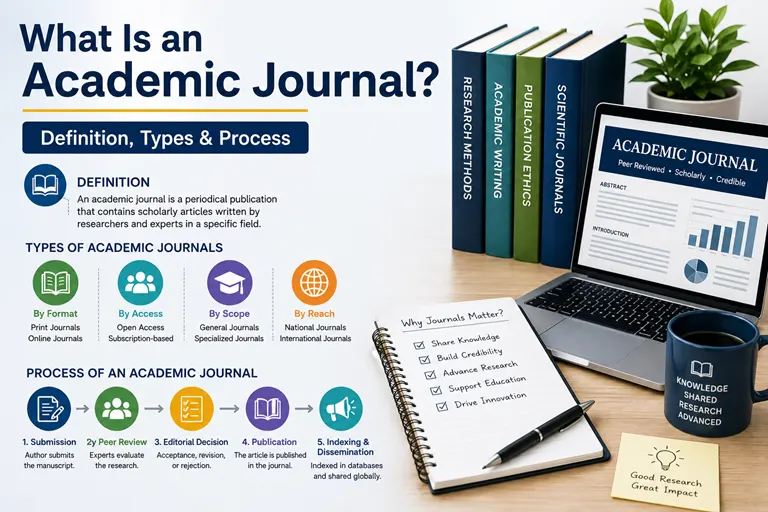
Academic Journal: Definition
An academic journal can be defined as a regularly published, peer-reviewed or editorially reviewed periodical that contains original scholarly articles within a defined subject area, intended primarily for an audience of researchers, academics, and practitioners in that field.
Three elements define this concept:
- Periodicity: It publishes on a recurring schedule — issues, volumes, or continuous online releases — rather than as a one-time document.
- Scholarly content: Articles report original research, review existing literature, or contribute expert analysis within a discipline.
- Editorial structure: Content passes through some form of evaluation — peer review, editorial review, or both — before publication.
How an Academic Journal Differs From Other Publications
The term is sometimes used loosely, so it helps to see how it compares against related but distinct types of scholarly output.
| Publication Type | What It Is | Key Difference From a Journal |
|---|---|---|
| Academic journal | Recurring periodical containing multiple peer/editorially reviewed articles | Ongoing, structured, multi-article publication |
| Research paper | A single piece of scholarly writing reporting original research | Published within a journal, not a publication in itself |
| Conference proceedings | A compiled collection of papers presented at an academic conference | Tied to a single event, not an ongoing periodical |
| Thesis or dissertation | A long-form academic document submitted for a degree | Institutional requirement, not journal-published content |
| Preprint | A research manuscript shared publicly before formal peer review | Not yet reviewed or formally published by a journal |
| Book or monograph | A single, standalone scholarly publication on one topic | Not periodical; typically authored and published once |
Understanding these distinctions matters because each type carries different expectations around review, citation, and academic recognition.
Why Academic Journals Matter in Research
Academic journals serve several functions that make them central to scholarly work:
- Formal communication: They give researchers a structured, citable way to share findings.
- Quality control: Editorial and review processes help filter for methodological soundness, though standards vary between journals.
- Knowledge continuity: Published articles let other researchers build directly on prior work through citation.
- Career and institutional relevance: Publication record is often factored into academic evaluation, funding decisions, and institutional rankings.
- Permanent archive: Journals maintain a lasting, searchable record of research contributions over time.
Types of Academic Journals
Academic journals vary along several dimensions, and understanding these categories helps clarify what "academic journal" actually covers:
By access model:
- Open access journals — content is freely available to readers, often supported by author or institutional publication fees
- Subscription-based journals — access is restricted to paying subscribers or institutions
- Hybrid journals — combine subscription access with an optional open-access route for individual articles
By scope:
- Subject-specific journals — focused on one discipline or subfield
- Multidisciplinary journals — covering research across several related fields
By review model:
- Peer-reviewed journals — submissions are evaluated by independent subject-matter experts
- Editorially reviewed journals — evaluated primarily by in-house editorial staff, without external peer review
It's worth stressing that review models aren't uniform across all journals — the rigor, transparency, and structure of review depend on each journal's own editorial policies, so it's important to check a specific journal's process rather than assume a standard applies universally.
How an Academic Journal's Publishing Process Works
Understanding the mechanics behind journal publishing clarifies what actually happens between a researcher writing a manuscript and that manuscript appearing in print or online.
Step 1: Manuscript Submission
Authors prepare their manuscript according to the target journal's guidelines and submit it, typically through an online submission portal.
Step 2: Editorial Screening
An editor checks the manuscript for basic scope fit, formatting compliance, and any immediate ethical red flags before deciding whether it proceeds to review.
Step 3: Peer or Editorial Review
Depending on the journal's model, the manuscript is evaluated either by independent external reviewers or by internal editorial staff, assessing originality, methodology, and contribution to the field.
Step 4: Revision
Authors typically respond to reviewer or editor feedback, sometimes across multiple rounds, refining the manuscript before a final decision is made.
Step 5: Acceptance and Production
Once accepted, the manuscript undergoes copyediting and formatting, and is scheduled into a specific volume and issue.
Step 6: Publication
The finished article is published — often online first — and becomes part of the journal's permanent archive.
Key Identifiers Used by Academic Journals
Two technical identifiers are central to how academic journals function in the broader scholarly ecosystem:
- ISSN (International Standard Serial Number): A unique code identifying the journal itself as a distinct periodical, separate from similarly titled publications. Print and online editions typically carry separate ISSNs.
- DOI (Digital Object Identifier): A persistent identifier assigned to individual articles, keeping them findable and citable even if hosting locations change.
Both are administrative and technical tools — neither one is an indicator of a journal's prestige, quality, or guaranteed presence in any specific index or database.
What Makes a Credible Academic Journal
Not every publication calling itself a "journal" meets the same editorial standards. Markers commonly associated with credible academic journals include:
- A clearly defined and consistently enforced scope
- A qualified, actively engaged editorial board
- A documented and transparent review process
- Publicly available publication ethics and policies
- Consistent adherence to a publication schedule
- Accurate, structured article metadata
- Transparent handling of corrections and retractions
How ScholarJMS Supports Academic Journal Management
Running an academic journal — regardless of its size or discipline — involves coordinating submissions, review, editorial decisions, and publication in a consistent, trackable way. ScholarJMS is a journal management and publishing platform built to support this operational side of academic publishing.
For editorial teams, this can include support for:
- Manuscript submission handling, giving authors a structured intake process
- Editorial workflow coordination, routing manuscripts through screening and review stages
- Peer-review management, organizing reviewer assignments and feedback
- Issue and archive management, keeping published content organized by volume and issue
- Journal website support, maintaining scope, policy, and editorial board pages in one place
This kind of infrastructure doesn't replace editorial judgment — it supports the consistency and traceability that credible academic journals depend on.
9. FAQ Section
What is an academic journal in simple terms?
An academic journal is a regularly published collection of scholarly articles focused on a specific field, evaluated through some form of editorial or peer review before publication.
Is an academic journal the same as a research paper?
No. A research paper is a single piece of scholarly writing, while an academic journal is the ongoing periodical publication in which multiple research papers and other article types are published.
Are all academic journals peer-reviewed?
Not necessarily. Some journals use formal peer review by external experts, while others rely on internal editorial review. Review rigor and transparency vary by journal, so it's important to check each journal's stated policy.
What is the difference between an academic journal and a conference proceeding?
An academic journal is an ongoing periodical publishing new articles on a recurring schedule, while conference proceedings are a one-time compilation of papers tied to a specific academic conference.
Does an academic journal need an ISSN?
An ISSN is generally used to formally identify a journal as a distinct periodical and is often expected for library cataloging and indexing consideration, though requirements vary by country and registration body.
How do I know if an academic journal is credible?
Look for a clearly defined scope, a qualified editorial board, a transparent review process, publicly available publication ethics policies, and a consistent publication history.
How does journal management software help academic journals?
Journal management software, such as ScholarJMS, helps editorial teams manage manuscript submissions, peer review, editorial decisions, and issue publishing from a centralized system.
10. CTA Block
Setting Up or Managing an Academic Journal? Let's Talk.
If you're launching a new academic journal, setting up journal publishing infrastructure, improving your editorial and peer-review workflow, or need support with DOI registration through Crossref, our team is available to provide practical technical guidance.
Mr. Darshan Patel (ME-CE)
COO & Journal Publishing Technology Consultant
Sequence Research & Development Pvt. Ltd.
Ahmedabad, Gujarat, India
📧 Email for Journal Setup & Crossref DOI: inquiry@ojscloud.com
📱 WhatsApp for Journal Setup & Crossref DOI: +91 82003 85143