

Why Every Journal Should Use Both Submission ID and Publication ID Instead of a Single Article Number
Learn the difference between Submission ID and Publication ID in academic publishing. Discover why international journals use two different article identifiers and how ScholarJMS follows global publishing standards.
Why Do Journals Assign Two Different IDs to Every Article? If you have ever submitted a manuscript to a research journal, you probably received...
Why Do Journals Assign Two Different IDs to Every Article?
If you have ever submitted a manuscript to a research journal, you probably received an email containing something like:
Submission ID: SUB-2026-0158
Many authors naturally assume this will remain the article's permanent identification number.
However, that is not how professional academic publishing works.
Modern journal publishing separates an article's journey into two distinct phases:
- Submission and Editorial Processing
- Publication and Long-Term Record Keeping
Because these two stages have completely different purposes, professional journal management systems assign two different identifiers.
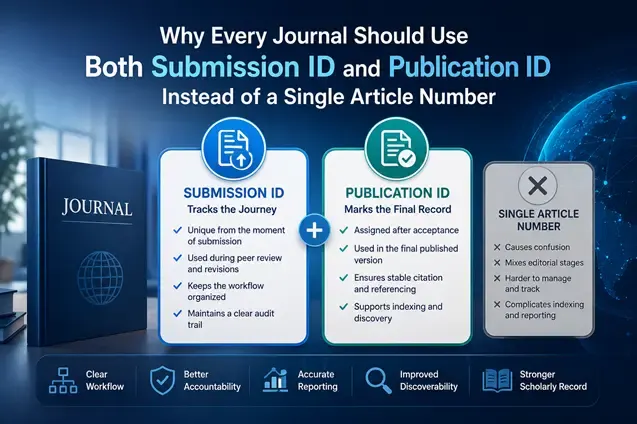
These are:
- Submission ID
- Publication ID
Understanding the difference helps editors, reviewers, publishers, indexing agencies, and authors communicate more efficiently while maintaining an organized publishing workflow.
The Complete Lifecycle of a Journal Article
Every manuscript passes through several stages before becoming a published article.
|
01
Author Submission
The author submits the manuscript and supporting documents to the journal.
|
→ |
02
Submission ID Generated
A unique Submission ID is created for manuscript tracking and communication.
|
→ |
03
Editorial Screening
Editors verify the manuscript's scope, quality, formatting and policy compliance.
|
|
06
Acceptance
The editor confirms that the manuscript meets the journal's publication standards.
|
← |
05
Revision
The author revises the manuscript according to reviewer and editor feedback.
|
← |
04
Peer Review
Independent reviewers evaluate the manuscript and provide recommendations.
|
|
07
Ready for Publication
The accepted manuscript enters copyediting, formatting and final preparation.
|
→ |
08
Publication ID Assigned
A permanent Publication ID is assigned to the final approved article.
|
→ |
09
Published Online
The article is published online and becomes available to readers worldwide.
|
|
Submission ID
Used to track the manuscript during editorial processing.
|
Publication ID
Permanently identifies the final published article.
|
Notice that the Publication ID is assigned much later than the Submission ID.
This is intentional.
What is a Submission ID?
A Submission ID is a temporary manuscript identification number generated immediately after an author submits a manuscript.
Example:
SUB-2026-0158
This ID exists from the very first second the manuscript enters the journal system.
Its primary purpose is to help everyone involved identify the manuscript during editorial processing.
This includes:
- Authors
- Editors
- Associate Editors
- Reviewers
- Editorial Office
- Production Team
Think of it as the manuscript's tracking number while it travels through the editorial workflow.
Why is the Submission ID Important?
Imagine a journal receiving:
- 100 submissions every month
- 500 submissions every year
- thousands of emails between authors and editors
Without a Submission ID, identifying the correct manuscript would become extremely difficult.
Instead of writing:
"Regarding my article entitled..."
everyone simply refers to:
Submission ID: SUB-2026-0158
This avoids confusion when articles have similar titles or multiple revised versions.
What Does the Submission ID Do?
A Submission ID helps with:
- Manuscript tracking
- Editorial communication
- Reviewer assignment
- Revision management
- Internal reporting
- Workflow automation
- Editorial statistics
It is primarily an editorial management identifier, not a publication identifier.
What is a Publication ID?
A Publication ID is the article's permanent identification number assigned only after the manuscript has successfully completed the editorial process and is ready for publication.
Example:
PUB-2026-0042
Unlike the Submission ID, this identifier remains associated with the published article permanently.
Why Isn't the Publication ID Assigned Earlier?
This is one of the most common questions publishers ask.
The answer is simple.
Not every submitted manuscript becomes a published article.
Some manuscripts may be:
- Rejected
- Withdrawn
- Declined after review
- Archived
- Returned without review
Assigning permanent publication numbers to rejected manuscripts would create unnecessary gaps and confusion in the publication record.
Therefore, Publication IDs are generated only for manuscripts that are actually published.
A Practical Example
Suppose your journal receives the following submissions.
When publication begins, only accepted articles receive Publication IDs.
Notice something interesting.
The Submission ID and Publication ID are completely different.
This is perfectly normal.
Article Lifecycle Example
This workflow ensures complete traceability throughout the manuscript's lifecycle while maintaining a clean and professional publication record.
Submission ID vs Publication ID
Why Professional Journals Prefer Two Different IDs
Using separate identifiers provides several operational advantages.
1. Better Editorial Management
Editors can track every manuscript regardless of its publication outcome.
2. Cleaner Publication Records
Only published articles receive permanent article numbers.
3. Better Organization
Rejected manuscripts never interfere with the numbering of published articles.
4. Easier Reporting
Editorial offices can generate accurate statistics on submissions, acceptances, rejections, and publications.
5. Professional Workflow
The editorial office and production team can work independently without changing manuscript references.
Can the Publication ID Follow the Publishing Order?
Yes.
Many journals prefer Publication IDs to be sequential.
For example:
PUB-2026-0001
PUB-2026-0002
PUB-2026-0003
PUB-2026-0004
This keeps published articles organized in chronological order within an issue or volume.
Meanwhile, Submission IDs continue reflecting the order in which manuscripts were originally received.
What Happens to Rejected Articles?
Rejected manuscripts keep only their Submission ID.
Example:
Submission ID
SUB-2026-0185
Status
Rejected
Publication ID
Not Assigned
This ensures editorial records remain complete without allocating permanent publication numbers to unpublished work.
Do International Journals Follow This Practice?
Yes.
Many professional publishers and advanced journal management systems maintain separate identifiers for manuscript processing and publication records.
This approach supports a clear separation between the editorial workflow and the published scholarly record. It also aligns with best practices used by journals seeking inclusion in major indexing services and maintaining well-organized publication archives.
Can a Journal Use the Same Number for Both?
Technically, yes.
A journal may choose to use a single identifier for both submission and publication if its editorial board prefers a simplified workflow.
However, there are important considerations.
If rejected or withdrawn manuscripts receive permanent numbers, the publication sequence will contain gaps. Over time, this can make publication records less organized and may complicate reporting and production workflows.
For this reason, larger journals and journals with significant submission volumes generally benefit from maintaining separate Submission IDs and Publication IDs.
How ScholarJMS Handles Article IDs
ScholarJMS follows internationally accepted publishing workflows by supporting separate identifiers for manuscript processing and publication.
With ScholarJMS:
- Every submitted manuscript automatically receives a unique Submission ID.
- Editors and reviewers use the Submission ID throughout peer review and editorial processing.
- Only articles that successfully complete the editorial workflow receive a Publication ID.
- Publication IDs can be generated sequentially to maintain the chronological order of published articles within each journal issue.
- Both identifiers remain linked internally, ensuring complete traceability from submission to publication.
At the same time, ScholarJMS recognizes that every journal has its own editorial policies. If a journal's editorial board decides to use a common identifier for both submission and publication, the platform can be configured accordingly. This flexibility allows journals to adopt the workflow that best matches their operational preferences while still maintaining an organized publishing process.
Frequently Asked Questions
Does every manuscript receive a Publication ID?
No. Only manuscripts that are accepted and prepared for publication receive a Publication ID.
Can two articles have the same Submission ID?
No. Every Submission ID is unique.
Does the Submission ID change after publication?
No. It remains stored in the journal's internal records for historical tracking and workflow management.
Is the Publication ID the same as a DOI?
No. A Publication ID is an internal journal identifier. A DOI is a globally registered digital identifier assigned through organizations such as Crossref or DataCite.
Can Publication IDs be sequential?
Yes. Many journals generate Publication IDs in sequence to maintain the publication order of articles within an issue or volume.
Can our journal use the same number for both Submission ID and Publication ID?
Yes. While ScholarJMS recommends separate identifiers as a best practice for efficient editorial management and cleaner publication records, the system can also be configured to use a single identifier if that aligns with your journal's editorial policy.
Final Thoughts
A research article has two very different journeys. The first is its editorial journey, where it is submitted, reviewed, revised, and evaluated. The second begins only after acceptance, when it becomes part of the permanent scholarly record.
Using separate Submission IDs and Publication IDs keeps these two journeys organized, reduces confusion, simplifies editorial communication, and preserves a clean publication history.
For journals that aim to follow professional publishing standards and scale their operations efficiently, maintaining distinct identifiers is a practical and widely adopted approach. At the same time, journals with different operational preferences may choose to use a single identifier, and a flexible journal management system should support both models.
With ScholarJMS, publishers have the freedom to choose the workflow that best fits their editorial process while ensuring every manuscript is managed accurately from submission to publication.