

Research Journal Setup: A Practical Configuration Guide for Publishers
Research journal setup explained - from choosing a publishing platform to configuring peer review, DOI, and metadata. A practical guide with ScholarJMS support.
Research Journal Setup: A Practical Configuration Guide for Publishers Research journal setup is often described in terms of editorial decisions...
Research Journal Setup: A Practical Configuration Guide for Publishers
Research journal setup is often described in terms of editorial decisions - scope, editorial board, policies - and rightly so, since those decisions shape everything else. But there's a second, equally important layer that gets less attention: the actual technical and operational configuration that turns those editorial decisions into a functioning publishing system. Defining a peer-review policy on paper is one thing; configuring a submission system so that policy is actually enforced consistently, submission after submission, is another.
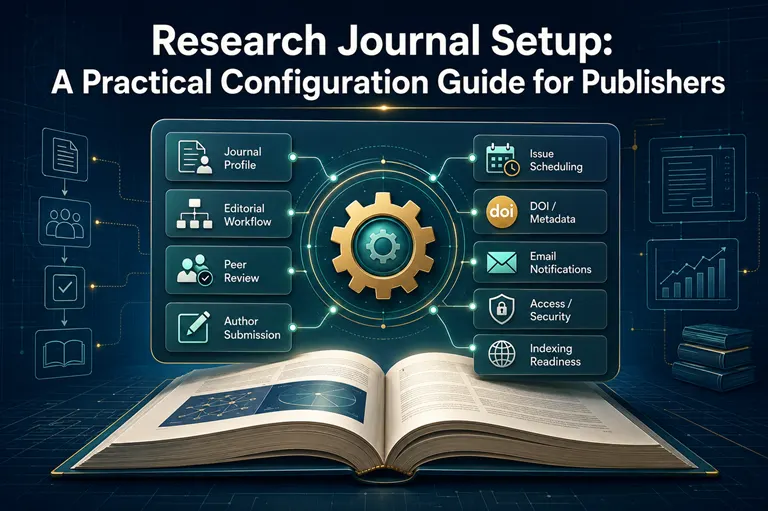
This guide approaches research journal setup from that configuration angle - the practical decisions publishers face once the editorial foundation is in place and it's time to actually build the system the journal will run on. It covers choosing between publishing infrastructure options, configuring your peer-review and metadata workflows correctly, and avoiding the technical gaps that tend to surface only after a journal has already published several issues. It also looks at how a platform such as ScholarJMS fits into this configuration work, and where to get help with technical requirements like Crossref DOI setup.
What Does "Setup" Mean Once the Editorial Groundwork Is Done?
By the time a founding team has defined scope, recruited an editorial board, and drafted policies, the remaining work shifts from "what should this journal be" to "how will this journal actually operate day to day." That's the configuration layer: choosing and setting up the systems that will handle submissions, track manuscripts through review, manage reviewer communication, assign DOIs, and publish finished issues.
This is the stage where publishers often discover gaps between what their policies say and what their tools can actually support. A journal might have a well-written double-blind review policy, for example, but if the submission system doesn't support anonymizing manuscripts automatically, that policy has to be enforced manually - a process that becomes error-prone as volume grows. Getting the configuration layer right means choosing infrastructure that can actually execute your editorial decisions, not just describe them.
Choosing Your Publishing Infrastructure
Before configuring anything, publishers need to decide what kind of system they'll build the journal on. Broadly, there are three paths.
The first is a fully custom build - a website and submission system developed from scratch. This offers maximum flexibility but requires significant technical resources to build and, more importantly, to maintain over time as requirements evolve.
The second is self-hosted open-source software, such as OJS (Open Journal Systems), which provides a free starting framework but still requires hosting, technical maintenance, and configuration expertise to run reliably, particularly as a journal scales.
The third is a managed journal publishing platform, such as ScholarJMS, which provides submission handling, editorial workflow, peer review coordination, and publishing tools as a maintained service, reducing the technical burden of hosting and upkeep. This path generally trades some low-level customization for faster setup and lower ongoing technical overhead.
There's no universally correct choice - the right path depends on the publisher's technical resources, the number of journals they plan to manage, and how much long-term maintenance they're prepared to take on. What matters most is that the choice is made deliberately, based on actual operational capacity, rather than defaulting to whatever seems cheapest at the outset without considering maintenance costs down the line.
Configuring the Submission System
Once infrastructure is chosen, the submission system needs to be configured to match your journal's actual policies, not just installed with default settings. This includes setting up required submission fields (title, abstract, keywords, author details, conflict-of-interest disclosures), configuring file format and formatting requirements, and setting up any automated checks - such as plagiarism screening integration - your policies call for.
If your peer-review policy specifies blind review, the system needs to be configured to strip or anonymize identifying information appropriately before manuscripts reach reviewers. If you require structured cover letters or supplementary data submissions, those fields need to be built into the intake form rather than handled through follow-up emails. Testing this configuration with a sample submission before going live - rather than assuming default settings match your policy - catches mismatches early.
Configuring the Editorial and Review Workflow
The editorial workflow configuration determines how manuscripts move through your system after submission. This includes setting up the screening stage so editors can quickly flag out-of-scope submissions, configuring reviewer assignment so manuscripts route to editors with the right subject expertise, and setting reasonable default deadlines for reviewer responses and reports.
It's also worth configuring automated reminders for approaching deadlines, since manual follow-up becomes unsustainable once a journal is running multiple concurrent review cycles. Decision letter templates should be set up in advance, aligned with your journal's actual editorial voice and policy language, so decisions are communicated consistently rather than drafted from scratch each time.
Configuring DOI and Metadata Infrastructure
DOI and metadata configuration is one of the most consequential technical setup tasks, because errors here are difficult to correct after articles are published. Setup involves registering with a DOI registration agency - Crossref being the standard choice for most scholarly journals - and configuring how your system generates and deposits metadata for each article.
This metadata needs to be complete and accurate: author names and affiliations, abstracts, keywords, references, and publication dates, all structured in the format your registration agency requires. If your publishing platform supports automated metadata deposit, configuring this correctly from the first published article saves considerable manual cleanup work later, since retrofitting accurate metadata across a growing archive is far more labor-intensive than setting it up correctly from the start.
Configuring the Journal Website and Content Structure
Beyond the informational pages every journal needs - about, scope, editorial board, policies - website configuration includes setting up the issue and volume structure your journal will use, configuring how archives are organized and searched, and setting up article page templates that display metadata, DOI links, and citation information consistently across every published piece.
It's also worth configuring basic technical SEO elements at this stage: clean, descriptive URLs for article pages, structured metadata markup, and mobile-responsive templates. These are easier to configure correctly from the start than to retrofit across an existing archive of published content.
Common Configuration Mistakes
A frequent issue is installing or activating a publishing system with default settings and never revisiting them against the journal's actual policies - resulting in a mismatch between what the policy page says and what the system actually enforces. Another is failing to test the submission-to-decision workflow end to end before going live, which means the first real submissions surface configuration gaps in production rather than in testing.
Metadata is often treated as an afterthought, configured loosely at first and only tightened up after inconsistencies start affecting citation accuracy. Some journals also under-invest in reviewer workflow configuration, relying on manual email tracking well past the point where automated reminders and centralized tracking would save meaningful editorial time. And DOI registration is sometimes delayed until after several issues have already been published, creating a backlog of articles that need metadata deposited retroactively.
How ScholarJMS Supports Research Journal Setup
Much of the configuration work described above - submission system setup, editorial workflow rules, reviewer coordination, metadata structuring - is built into what a dedicated journal publishing platform provides out of the box. ScholarJMS is a journal management and publishing platform designed to reduce the technical configuration burden that comes with setting up a research journal from scratch.
Rather than building submission forms, review-routing logic, and metadata deposit processes independently, publishers using a platform such as ScholarJMS configure these processes within an existing system built for journal publishing - covering manuscript submission handling, editorial workflow coordination, peer-review management, author and reviewer communication, article and issue management, and DOI and metadata workflows. This shifts the setup effort from technical development toward configuration and editorial decision-making, which tends to be a faster and more maintainable path, particularly for teams without dedicated technical staff.
Research Journal Setup Configuration Checklist
- Publishing infrastructure selected (custom, self-hosted, or managed platform)
- Submission form fields configured to match author guidelines
- Blind/open review anonymization configured, if applicable
- Reviewer assignment and deadline defaults set
- Automated reviewer reminders configured
- Decision letter templates prepared
- DOI registration agency membership completed
- Metadata deposit process configured and tested
- Issue and volume structure defined in the system
- Archive organization and search configured
- Article page templates set up with metadata and DOI display
- Basic technical SEO elements configured (URLs, structured metadata, mobile responsiveness)
- End-to-end workflow tested with a sample submission before going live
Frequently Asked Questions
What is research journal setup? Research journal setup covers both the editorial foundation of a journal - scope, editorial board, policies - and the technical configuration of the systems used to manage submissions, peer review, DOI assignment, and publishing.
Should I build custom software or use an existing platform? This depends on your technical resources and long-term maintenance capacity. Custom builds and self-hosted software like OJS offer flexibility but require ongoing technical upkeep, while managed platforms such as ScholarJMS reduce technical overhead in exchange for working within an established system.
Why does submission system configuration matter? If the submission system isn't configured to match your actual editorial policies - such as blind review requirements or required disclosures - those policies end up enforced manually and inconsistently, which becomes harder to manage as submission volume grows.
When should DOI infrastructure be configured? DOI and metadata infrastructure should ideally be configured before publishing your first issue, since correcting incomplete or inaccurate metadata across an already-published archive is significantly more labor-intensive than setting it up correctly from the start.
Does ScholarJMS handle technical configuration for journal setup? ScholarJMS provides built-in tools for manuscript submission, editorial workflow, peer-review management, and DOI/metadata workflows, reducing the amount of independent technical development required to configure a research journal.
How do I know if my journal's technical setup matches its policies? Testing your full submission-to-decision workflow with a sample manuscript before launch is the most reliable way to confirm your system actually enforces the policies you've published, rather than assuming default settings are sufficient.
Is self-hosted software cheaper than a managed platform? Self-hosted software may have lower upfront licensing costs but typically requires ongoing hosting, maintenance, and technical expertise, which should be factored into a full cost comparison rather than evaluating initial cost alone.
Need Help With Your Research Journal Setup or Crossref DOI Registration?
Whether you're setting up a new research journal, configuring publishing infrastructure, establishing peer-review workflows, or implementing Crossref DOI registration, our team can provide practical, technical guidance based on real-world academic publishing experience.
Mr. Darshan Patel (ME-CE)
COO & Journal Publishing Technology Consultant
Sequence Research & Development Pvt. Ltd.
Ahmedabad, Gujarat, India
📧 Email for Journal Setup & Crossref DOI Inquiries: inquiry@ojscloud.com
📱 WhatsApp for Journal Setup & Crossref DOI: +91 82003 85143